Rethinking vision: Building systems that understand, not just see
Rethinking vision: Building systems that understand, not just see
:format(webp))
For decades, advances in public safety technology have expanded visibility—making more information available and accessible in critical moments.
But this alone is no longer enough.
Visibility alone does not produce understanding. More footage does not lead to better outcomes when teams cannot identify what matters in time to act. In many organizations, an excess of data compounds the challenge — shifting the burden onto personnel to sift through large volumes of information long after critical moments have passed. That model is, by design, reactive.
We believe there is a better path forward.
The opportunity before us is to move from systems that passively record everything to systems that actively help teams recognize what matters as it unfolds, enabling verification in real time and response before situations escalate. That shift requires a more disciplined definition of what we are asking these systems to do.
Not to observe everything, but to recognize specific, defined conditions. Not to collect more data, but to surface meaningful signals early enough to act on them.
This is the foundational principle behind Axon Vision.
As we introduce Vision at Axon Week, we introduce a different architectural approach, one that prioritizes operational understanding over passive observation and is intentionally constrained by design.
Validating the Method Before Scaling It
Before deploying this in public safety environments, we needed to answer a more basic question: does this approach actually work in the real world?
Pursuing that answer required a level of computer imaging capability we knew we couldn't build fast enough on our own. That pursuit led us to Groundlight, an innovative technological imaging company whose researchers had already been working through many of the same questions we were asking. What we found when we looked closely wasn't just a technology we could use. It was a team that had independently arrived at the same foundational conviction: that detection systems should be built around what can be clearly seen and verified, not inferred, and that human judgment should remain at the center of any consequential decision.
Groundlight had already begun validating that conviction in practice. They had tested the approach in lower-risk environments, including retail and enterprise settings, asking the same questions we would have asked: Can the system reliably identify specific, observable conditions? Can those signals reach the right people in time to matter? Where does it fall short?
That work didn't just accelerate our timeline. It shaped how we think about the problem. When Groundlight joined Axon, we had what we needed to build something we knew customers, and the communities they serve, would value: a way to make cameras provide meaningful intelligence seamlessly, without adding burden to the people relying on them.
Where Vision Applies and How We Are Sequencing Deployment
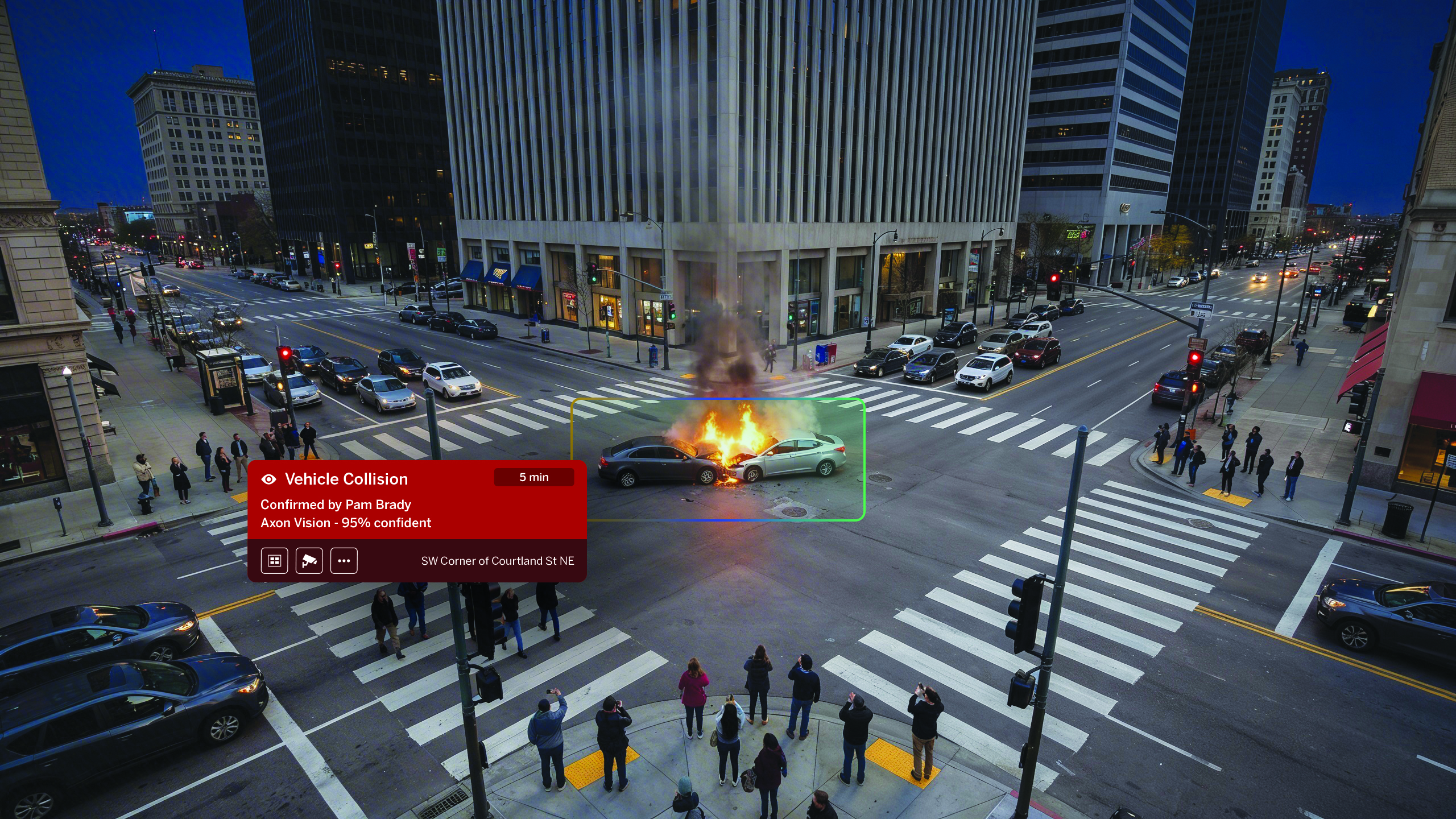
Axon Vision is built to recognize defined conditions in video as they happen and alert teams early enough to act. That scope is deliberate, reflecting both what the system is designed to do and what it isn't.
We are starting in defined environments where signals are clearest and where the cost of error is lowest, not an open-ended monitoring platform.
In enterprise and commercial settings, that means improving operational awareness and flagging safety risks in controlled, predictable environments. In corrections, the application carries more weight. Vision is scoped to support staff awareness of specific, predefined indicators within tightly defined contexts, without expanding monitoring beyond those boundaries or substituting for the judgment of the people on the ground. A common use case might be identifying early signs of a medical emergency or escalating conflict, so staff can respond more quickly.
We are sequencing deployment deliberately. Lower-risk environments come first as a structured learning process. Each phase tells us where the system holds up, where it needs work, and where it should not be used at all. That is how confidence gets built, in the technology and in its appropriate use.
A human is always in the loop. The system doesn't make decisions. It shares its level of confidence in what it's seeing, and a person determines what happens next. That holds true as the environments grow more complex and the stakes rise.
A Shared Model of Responsibility
Responsibility for outcomes doesn't shift because a system flagged something. It stays with the people who act on it. Our responsibility as a technology provider is to build systems with clear constraints around what is permitted, what is limited, and where human judgment must remain authoritative. That includes being transparent about how the system operates, where uncertainty exists, and how decisions get surfaced.
The operator defines the context. The operator makes the decisions. The operator owns the outcomes. That is the model, and it shapes how we design, document, and deploy Vision.
To make that concrete, we’re starting with a set of standards that guide how Axon Vision is designed.
Objective and Verifiable: Every detector is grounded in observable, testable conditions such as people counts, falls, and perimeter breaches. If a signal cannot be clearly defined and validated, it does not ship.
Clear Data Boundaries: Vision has explicit limits on what data is captured and how it is used. Those boundaries are visible in the product and enforced by design, not policy alone.
Human Oversight: Higher-impact alerts require human review and supervisory sign-off, with a clear audit trail. The system shares what it detects. People decide what to do about it.
Purpose-Bound Deployment: Vision is deployed through defined use cases with controls around retention, access, and export. Expanding that scope requires deliberate review.
These standards build on our broader Responsible Innovation framework and reflect how we are approaching the development and deployment of Vision. They were shaped through direct input from customers and informed by our Ethics and Equity Advisory Council, whose perspectives helped define these constraints from the outset.
As we move from field trials toward broader availability, we expect to refine these standards alongside the product. We will continue engaging closely with our Ethics and Equity Advisory Council, customers, and other stakeholders to ensure these principles are tested, challenged, and strengthened over time. That may also include thoughtfully introducing opportunities for customers to customize certain Vision capabilities, grounded in clear guardrails that prioritize rigor, objectivity, and protections against misuse, including preventing the targeting of protected classes.
We may refine how these tenets are expressed as the product matures. What will remain constant is the approach behind them: a commitment to building technology that earns trust and is deployed responsibly.
Where We Stand Today
We are also clear-eyed about where we are in this process. Strategic alignment is not the same as completion. As we progress toward field trials in mid-2026, our responsible innovation work remains active and ongoing across product design, performance testing, and external stakeholder engagement.
We are building and validating in parallel. Some elements are well established. Others are being refined through real-world feedback. This is by design. Responsible innovation is not a declaration made at launch. It is demonstrated over time through consistent decisions and transparent communication.
Between our announcement at Axon Week and targeted general availability in early Q4 2026, we are entering a deliberate phase of learning and iteration. This phase is how we earn the right to expand. It includes continued engagement with regulatory bodies and community stakeholders, ongoing refinement of system performance across deployment environments, and clear communication about the intended scope and limits of this technology. Progress will not be measured by capability alone. It will be measured by feedback directly from our customers and the communities they serve.
If we execute this well, the system will look meaningfully different from what came before: fewer tools that simply record, more that help teams understand in the moment. Less dependence on hindsight, more capacity to act as situations unfold.
More clarity. More accountability. More trust. That is the standard we are setting with Axon Vision. And it is the work ahead, not the announcement, that will determine how it helps protect life in the moments that matter most.