:format(webp))
At Axon Week 2026, one of the most valuable conversations focused on the way innovation gets adopted in public safety: through trust, partnership, operational reality, and a clear focus on outcomes.
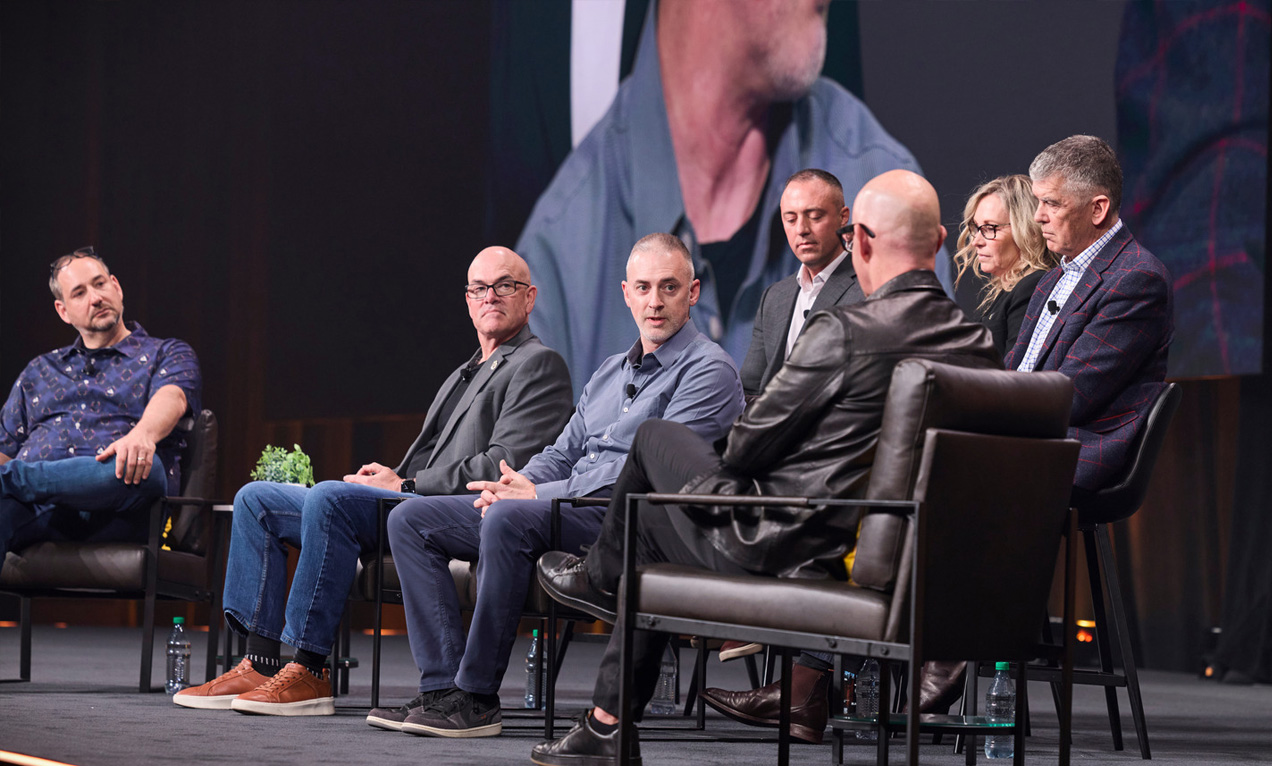
In this keynote conversation, two Axon leaders joined six leaders from across public safety to talk candidly about what’s working, what still needs improvement, and where technology can make the biggest difference next.
Panelists included:
Lee Bercaw: Chief, Tampa Police Department
Pat Labat: Sheriff, Fulton County Sheriff’s Office
Eric Watson: Chief, Chicopee Police Department
Dan Loughman: Colonel, Connecticut State Police
Sir Andy Marsh: CEO of the College of Policing, UK
Doreen Jokerst: Chief, Overland Park Police Department
Mike Wagers: Chief Customer Officer, Axon
Jeff Kunins: Chief Product Officer and Chief Technology Officer, Axon
The discussion covered AI, drones, policy, interoperability, officer experience, public trust, and the leadership required to make any new capability succeed. In this article, we’ll explore several key takeaways from the discussion. You can also watch the panel discussion right here:
Built on Trust: The Unfiltered Story of Innovation in Public Safety
Built on Trust: The Unfiltered Story of Innovation in Public Safety
Great public safety technology is built in partnership with agencies
A recurring theme throughout the panel was that meaningful innovation comes from close collaboration with agencies in the field.
Jeff Kunins framed that idea early in the session, saying that “great products are never built in isolation” and that the best results come from “building alongside customers” and learning directly from agency partners.
That same point showed up in practical examples from the field. For instance, Tampa Police Chief Lee Bercaw described how early access and beta participation helped create stronger internal buy-in. When Axon introduced Policy Chat, his team was invited to pressure test it.
When Policy Chat first came to us, they basically said, here, try to break it. And we gave a ton of feedback and all of that was accepted and changed and made the system better.
Chief Eric Watson explained how they saw Axon act as a technology partner throughout the implementation process:
We pushed everything out to our department in a matter of three months, and we needed a lot of support. [Axon] gave us what felt like more attention than we deserved. It was a really good process to go through with you guys.
The panel agreed that agencies do not simply want more than vendors who ship a product and then go silent; they want responsive partners who listen, iterate, and improve products based on real operational use. This trusted relationship is essential to the success of agencies around the world.
Language, policy, and transparency shape public acceptance
The panel made an important distinction between building a capability and earning support for its use.
Chief Doreen Jokerst, Overland Park Police Department, spoke directly to how terminology can shape perception, especially around sensitive technologies. She argued that leaders need to be precise and intentional in how they talk about new tools.
I do believe words matter...Intentional policy development and intentional language help technology resonate better with both leaders and the communities we serve.
The language agencies choose can either inflame concerns or clarify how a tool actually works. Her point was not cosmetic; it was operational. Clear language, paired with strong policy, can improve understanding among both agency leaders and the communities they serve.
That same theme came up again when the conversation turned to license plate readers and data sharing. Chief Bercaw emphasized that agencies need to communicate not just what the technology does, but what it does not do, and who controls the data.
Public trust, the panel suggested, is built through transparency, specificity, and repeated explanation grounded in real-world results.

Trust is the foundation for adopting fast-moving AI
As agencies evaluate long-term AI investments, leaders emphasized that adoption depends on trust: trust that products will evolve in ways that help agencies, trust that companies will act responsibly, and trust that implementation will be grounded in real needs.
Chief Lee Bercaw explained why Tampa was willing to take a long view on AI:
You’re setting your agency up for the future, and you need to be ahead of the curve. And part of that is being on the cutting edge of technology. If we’re not, we’re already behind.
Jeff Kunins acknowledged the weight of that responsibility, especially in a fast-changing AI environment, and emphasized that trust can be easily lost if it isn’t protected.
The panel also surfaced a practical truth: innovation moves fast, and agencies are trying to balance urgency with implementation discipline. Chief Eric Watson put it this way:
We feel it’s irresponsible not to try to get the latest and greatest to keep our officers safe and keep our community safe.
Agencies do not need to adopt everything immediately, but they should recognize that standing still carries risk.
Leadership and culture matter as much as the technology itself
One of the strongest points in the session came from Sir Andy Marsh, who reminded the audience that even the best technology will underperform if leadership and organizational culture aren’t aligned around it.
Leadership makes everything better. And you can deliver the best technology in the world into policing. Unless it’s got good leadership and culture around its implementation, it will be suboptimal, even fail.
That perspective broadened the conversation beyond product. Successful adoption requires standards, training, internal champions, policy clarity, and a culture that treats implementation as a leadership challenge, not just a purchasing decision.
This idea also connected to a larger theme in the keynote: technology should reduce noise, surface what matters, and help people make better decisions under pressure.
The most valuable innovation may be the least flashy
Some of the most compelling moments in the session focused on mundane but high-impact problems: paperwork, repetitive tasks, inmate counting, report writing, and data overload.
Rather than framing innovation only as futuristic, several speakers highlighted the value of using AI and automation to remove administrative drag and return time to the field.
Colonel Dan Loughman described that goal in practical terms as Connecticut State Police modernizes its systems:
It’s going to get troopers out from behind the desk and writing reports to out on the street.
Sheriff Pat Labat shared similar thinking for Corrections:
In corrections, technology can help us automate repetitive work so people can focus on higher-value tasks...We shut down an entire building for count time. If technology can do that more efficiently, it changes everything.
Jeff Kunins reinforced the same point from the product side, noting that some of the biggest gains come from improving “the boring but vital high-volume all day, every day tasks” so officers and staff can focus on work only humans can do. In other words, a key marker of success for the future of AI is it’s ability to remove friction at scale.
Agencies want connected systems, not silos
Interoperability came up repeatedly, both explicitly and implicitly.
Chief Jokerst argued that technology must work together in order to achieve the goal of safer communities.
Crime has no jurisdictional boundary, and technology shouldn’t either...You train together tactically. Your technology should work together too.
The panel also pointed to the growing value of connecting systems across 911, real-time operations, drones, vehicle intelligence, records, and evidence. That vision was less about any one product than about how information moves fast enough to support better decisions. When the data gets stuck in silos, it slows the decision-making.
Agencies are looking for platforms that reduce fragmentation, preserve control, and support collaboration without adding complexity.
Conclusion and Next Steps
While this summary captures a few key highlights, we encourage you watch the full keynote. The leaders in law enforcement shared from their own experience and wisdom gained from years working in public safety.
The future of public safety technology will be shaped by leaders who are willing to pair innovation with responsibility, speed with trust, and new capabilities with real operational discipline. If you want to be one of those leaders, this conversation is for you.
And of course, if you want to catch this kind of content live and in person, make sure you register for Axon Accelerate 2027.