:format(webp))
Why architecture determines what governance is possible
Automated license plate recognition, or ALPR, systems are now evaluated differently than they were even a few years ago. Agencies are no longer being asked only operational questions about read accuracy, coverage, and alert speed. They are increasingly being asked architectural questions alongside them. Where does the data live? Who controls access? How is sharing governed? What happens when a legal request is made?
These are not policy questions. They are structural ones, and they require structural answers.
Policy defines intent. Architecture determines what is actually enforceable.
That distinction is most likely to be overlooked when procurement focuses on camera specifications, coverage area, and deployment speed. An agency can write a strong data governance policy. But if the system is not designed to enforce that policy automatically, governance depends on human discipline rather than structural design. Leadership changes. Staffing turns over. Oversight expectations evolve. Systems that hold up over time are the ones that make governance observable, enforceable, and auditable by default.
Two approaches to sharing, and why the difference matters
Agencies evaluating ALPR systems, alongside the councils, oversight bodies, and communities they answer to, are effectively navigating a choice between two fundamentally different approaches to how data is owned, accessed, shared, and governed.
The distinction is not whether agencies can share data. It is whether sharing remains explicit, bounded, auditable, and revocable by the agency that owns the data. In an agency-controlled model, the architecture enforces that standard by design. That includes other jurisdictions, federal entities, and private networks. Access does not expand without an explicit decision by the agency. In a shared or network-based model, an individual agency's exposure boundaries can shift as new participants join, independent of that agency's own configuration decisions. Once data is shared, the originating agency may have limited visibility into where it propagated, who accessed it, and whether retention policies are being honored.
These are not superficial differences. They are structural ones that produce materially different governance outcomes. The distinction ultimately comes down to how exposure boundaries behave as deployments evolve.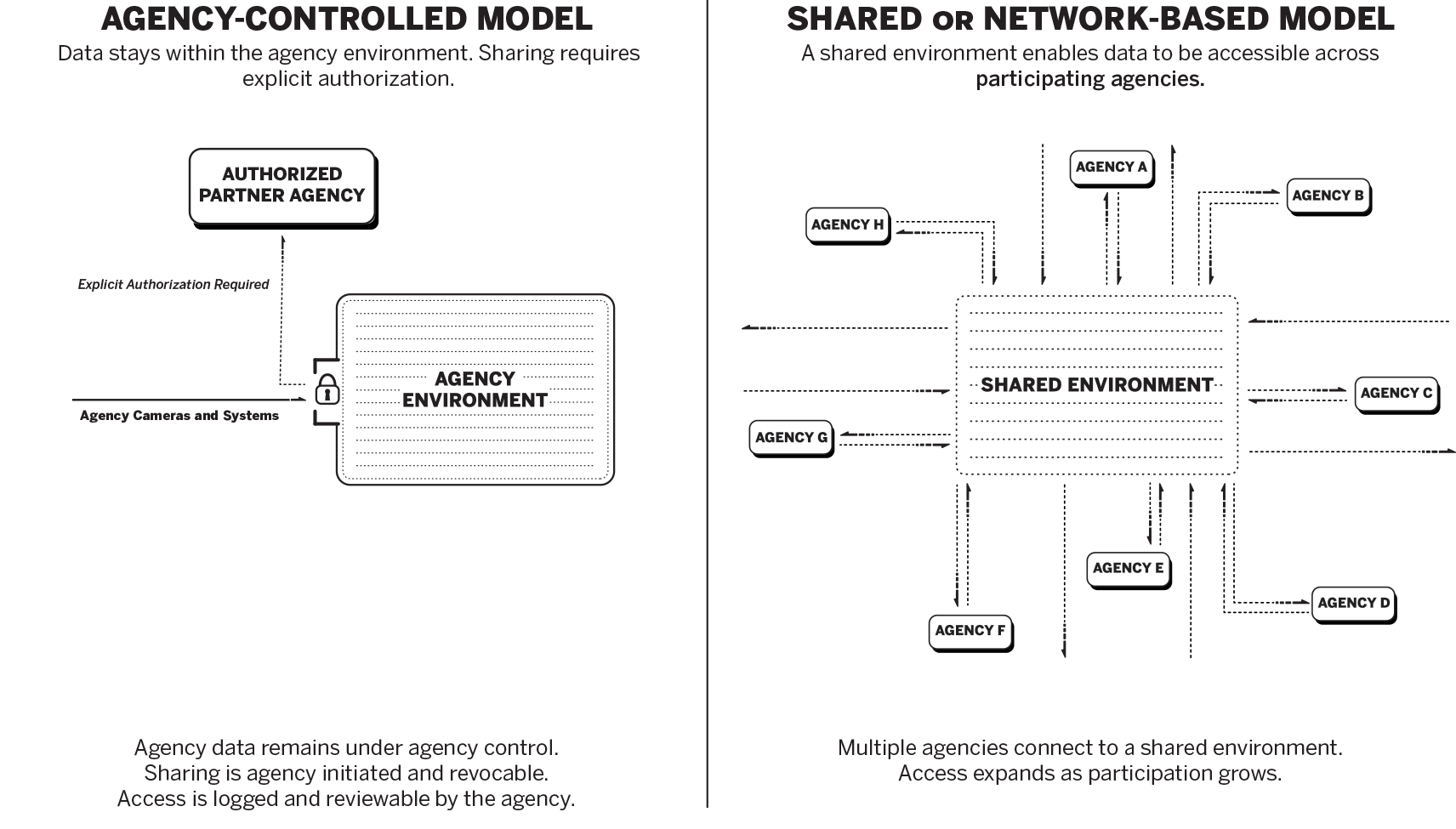
Design Area | Agency-Controlled Model | Shared / Network-based model |
Where Data Lives | Within the agency's controlled environment at all times | May be stored or accessible through environments extending beyond the originating agency |
Who can See the Data | Visibility does not change unless the agency takes explicit action | Exposure boundaries can expand as network participation grows, regardless of initial configuration |
How Data Is Shared | Explicit, deliberately configured, revocable, and architecturally prevented from occurring without agency action | Sharing architecture is designed for network participation; governance depends on configuration accuracy remaining correct over time |
How Long Data Is Kept | System-enforced based on agency policy | Once data is shared, the originating agency may have limited visibility into where it propagated, who accessed it, and whether retention policies are being honored |
Who Controls Disclosure | Agency retains full control | May involve multiple entities depending on architecture and participation structure |
If Something Goes Wrong | Impact contained to a single agency environment; audit trail intact and immediately reviewable | Impact scope and containment depend on how broadly data has propagated across the network |
Questions worth asking before you commit to a system
The architecture questions that matter most in an ALPR procurement are not always the ones vendors volunteer answers to. These are worth asking directly, and worth pressing on if the answers stay at the policy level.
Where does data physically reside, and under what conditions can it be accessed by parties outside the agency? A policy commitment that data is protected is different from an architectural guarantee that outside access is structurally prevented.
If sharing is enabled, what is the precise mechanism? Can it be enabled without a deliberate agency decision, and can it be fully revoked? The answer should describe an architectural constraint, not a default setting.
As the network grows or the vendor's policies change, what control does the agency retain? Can the agency exclude specific participants, limit which search types are visible to others, and opt out of sharing with new entrants without disrupting existing configurations? If the vendor's data sharing policies change, is the agency automatically notified and given the ability to opt out before those changes take effect?
If something goes wrong, is the impact contained to a single agency environment, or does it extend across the network? The answer to this question is determined by architecture, not policy.
These questions do not have policy answers. They have structural ones. How a vendor answers them, and whether those answers describe architectural properties or configuration options, is itself a meaningful signal.
How an agency-controlled model works in practice
Understanding the architecture distinction is one part of the procurement decision. Understanding how that architecture operates across real workflows is the other.
When detection, response, and evidence preservation happen across separate systems, the accountability record becomes fragmented. Reconstructing what happened, when, and why becomes an exercise in assembly rather than a continuous record. When those same workflows run inside a single governed environment, accountability is maintained continuously from the start. Workflow continuity is not an operational convenience. It is a governance mechanism.
The practical question for agencies is what this looks like once it is operationalized.
Axon Vehicle Intelligence functions as an agency-controlled workflow inside Fusus, Axon's real-time operations platform, connecting vehicle detections from Axon Fleet 3, Axon Outpost, Axon Lightpost, and certified partner cameras through Works With Axon into a single governed environment.
When cameras capture a detection, that information flows into Fusus, where authorized personnel can search connected sources, review hotlist alerts, and access operational context without switching systems. Search is not open-ended. Before results are returned, the user enters a reason for the search and selects an authorized offense category, so every search carries a documented purpose. Each search is tied to a named user and written to the audit record.
Because livestreaming is integrated directly into the workflow, personnel can move from detection to real-time visual context within the same governed operational environment. When a detection matches a hotlist, an alert is surfaced for human review. Personnel evaluate it, apply judgment, and determine the appropriate response.
Detection is automated. Operational judgment remains human.
When information becomes relevant to an investigation, it moves into Axon Evidence where it is preserved with chain of custody, agency-defined retention policies, and full audit logs intact. The chain from detection to response to case-building is continuous. Data does not transfer between systems or lose governance context along the way.
Access is governed by agency-defined permissions, every action is logged, and retention is enforced automatically. When sharing is enabled, it is explicitly configured by the agency that owns the data, visible at all times, and revocable by either side at any time. It starts only when the owning agency invites a specific partner and that partner separately accepts, so no relationship forms without a deliberate choice on both sides. Nothing is copied.
The receiving agency searches into the owning agency's system, the data stays under the owning agency's retention policy, and it cannot be passed on to anyone else. By default, only detections that match the receiving agency's own hotlist are exposed, the narrowest footprint that still delivers the alert. These are not policy commitments layered on top of the system. They are built into how it functions.
Governance that holds up over time
Earning approval to deploy ALPR is one milestone. Sustaining the governance that justifies it is the harder work. The accountability questions do not disappear after approval. They return with each renewal, each oversight review, and each public records request.
An agency-controlled architecture is designed to answer them directly. Retention is enforced automatically rather than manually maintained. Access permissions remain defined and reviewable. The audit record is the accountability mechanism. Every search, view, export, and sharing action against ALPR data is logged and available for review at any time. That record spans every connected source, including certified partner cameras through Works With Axon, so an agency can show exactly who accessed what, when, and why, and answer an oversight board, a council, or a public records request with a report rather than a reconstruction. No outside party has automatic, standing, or built-in access to agency data. When a legal request is made, it is directed to the agency as the data owner, and the agency remains the decision-maker in how it is handled.
When data ownership boundaries are unclear, public records become a legal risk
Public records requests are an increasingly significant pressure point. When data ownership boundaries are architecturally clear, agencies can define precisely what is subject to disclosure. When those boundaries are ambiguous by design, that determination becomes difficult to make and harder to defend. Agencies sharing data through network-based architectures may find themselves holding records documenting activity they did not originate and cannot fully govern. The complexity deepens across state lines: some states exempt LPR reads from public records requirements, others do not. When data has moved across jurisdictions, an originating agency may have no practical ability to control whether a recipient agency in a more permissive state produces records it never intended to be public. Architectural clarity around data ownership is not only a governance question. It is a legal one.
Legislation and community expectations also change over time. Agencies need systems that can adapt governance controls as those obligations evolve, not ones that lock in a single configuration at deployment and depend on manual workarounds to keep pace with what the law requires. This is also where the limits of a network-based model become clear: an agency's configuration controls what that agency does, but it does not control what the broader network does with that agency's data. By the time a misconfiguration surfaces, the agency may have been operating outside its stated governance commitments for months or years without knowing it.
Axon Vehicle Intelligence is developed under Axon's Responsible Innovation framework, which embeds privacy, accountability, and agency control directly into product design. Agencies can also choose to make governance information public through a transparency portal, disclosing retention policies, usage information, and the agencies they share data with, so a community can see how a program is governed rather than take it on faith. Axon's security certifications and compliance documentation are available at trust.axon.com.
Making the right procurement decision
The systems that hold up operationally are the ones agencies can stand behind publicly, and continue to defend, over time. Agencies are increasingly being evaluated on both.
When evaluating ALPR vendors, the questions that matter most are not about camera specifications or network size. They are about what the architecture makes possible. Who controls access. How sharing is governed. What happens when leadership changes, legislation shifts, or a legal request arrives. Whether the agency can demonstrate that the system is operating the way they said it would.
An agency-controlled architecture answers those questions by design rather than by policy. That distinction is what makes a deployment defensible not just at launch but over the full life of the system.
Choosing a system where governance is embedded in the architecture is not a hedge against scrutiny. It is what responsible procurement looks like in a category that now carries long-term institutional implications.
Learn more about Axon Vehicle Intelligence and agency-controlled ALPR workflows, or contact us to get started.