Customer Story Hub
Sarasota County Sheriff’s Office Streamlines Response, Reporting, and Evidence
At a Glance
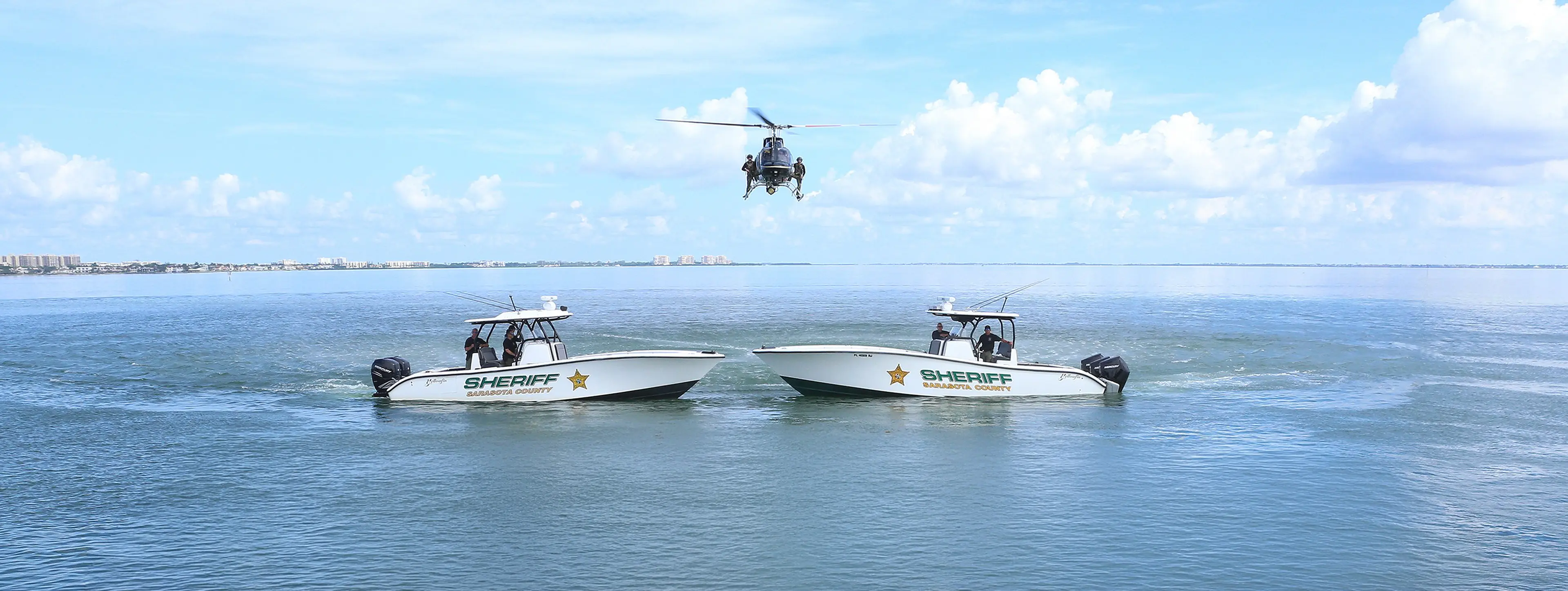
Agency: Sarasota County Sheriff’s Office
Population served: A rapidly growing, high-tourism Gulf Coast community in Sarasota County, Florida
Sworn / professional staff: Roughly 1,100 employees
Coverage area: Sarasota County and the surrounding Gulf Coast region
Key Solutions: Axon Evidence, Fleet 3, Axon Interview, Axon Records, Draft One, Redaction Assistant, Fusus, Axon 911, Outpost, Axon Standards, Lead Surface, TASER 10
Key Results
Sent 2,455 Community Requests that yielded 11,204 pieces of evidence, streamlining the evidence collection process
Eliminated interview room outages by 100% with Axon Interview
Coordinated rollout of multiple systems, backed by customer service
Accelerated report writing through the use of Draft One
Sharing digital evidence has become faster and more secure
Executive Summary
Sarasota County Sheriff’s Office is transforming the way it works by moving from disconnected, standalone systems to a single integrated technology ecosystem. The agency adopted Axon to reduce duplicated data entry, simplify training, improve reliability, and accelerate the work of patrol, investigators, records staff, and property evidence teams.
The agency is building a Real-Time Information Center around connected evidence, live camera access, community video requests, 911 streaming, and investigative tools that help deputies and detectives act faster. The result is a more efficient operational model that supports proactive policing, better investigations, and stronger service to the community.
The agency’s early experience with Axon Interview room, digital evidence sharing, redaction, and report-writing support has been especially rewarding. Though several modules are still rolling out, staff are already seeing fewer manual steps, faster access to information, and more time to focus on the core work of public safety.

About the Agency
Sarasota County Sheriff’s Office serves a rapidly growing county on Florida’s Gulf Coast. The area includes one of the nation’s most recognized beaches, sees a consistent stream of tourism year-round, and houses a community that continues to expand. That growth brings a need for adaptable public safety operations, especially as the agency balances patrol, investigations, corrections, court services, civilian support, and an increasingly sophisticated technology stack.
Captain Adam Kaskey leads the Investigations Bureau and is helping steer the agency through a broad modernization effort. Their approach combines innovative technology with operational strategy to reduce manual work, improve training consistency, increase speed, and support higher-quality investigations.
The Challenge
Before Axon, the agency relied on multiple standalone systems that created a heavy administrative burden. Deputies and officers were duplicating data entry. Property evidence teams were managing DVDs, thumb drives, and hard drives. Training staff had to teach users across too many different programs and passwords. And when systems did not integrate smoothly, each vendor could point to another when something broke.
We were duplicating that data entry over and over and over again, and it was creating a significant administrative effort.
That fragmentation slowed workflows, created more room for error, and forced staff to spend time managing technology instead of doing public safety work. For investigators, it meant additional hours typing, searching, moving files, and rebuilding case materials. For patrol, it meant less time in the field.
Interview room reliability was another pain point. The agency’s prior system went down frequently enough to create real operational and credibility problems. In some cases, the agency had to explain lost interviews to judges. That kind of disruption is more than an inconvenience; it undermines confidence in the agency’s processes and the quality of its case files.
The Solution
Sarasota County Sheriff’s Office chose to go all in on Axon because the agency wanted a platform they could trust, not a patchwork. They also knew it was a long-term decision, so they wanted a technology solution that would evolve with the agency over time.
We wanted to get rid of those standalone systems that you’re constantly trying to make conform to what you want them to do.
The agency’s deployment includes Axon Evidence, Axon Body 4, Fleet 3 in-car video systems, Axon Interview, Axon Records, Axon Standards, Draft One, Redaction Assistant, Axon Outpost, Prepared 911, Fusus, Lead Surface, TASER 10, and other components that fit into a broader operating model.
This ecosystem connects patrol, investigations, records, digital evidence, and real-time operations into one integrated workflow.

A connected RTIC foundation
The agency is building a Real-Time Information Center (RTIC) around live video, camera ingestion, community video requests, and Axon 911 streams.
Fusus is central to that effort, giving supervisors and analysts more immediate access to information as events unfold. The agency is also ingesting public and transportation-related camera feeds, expanding the number of sources that can support live awareness and investigations.
AI that is purpose-built for public safety
The agency opted for the Axon AI Era Plan after a deliberate review of how AI is used, secured, and governed. Captain Kaskey said the agency was not moving toward AI casually; it wanted a solution that met law enforcement’s compliance expectations and did not create unnecessary risk.
That clarity made the technology easier to adopt. The agency moved forward after learning how the system works, what it does not do, and how it fits within a law enforcement environment.
Results
Customer support that matched the pace of the rollout
Sarasota County Sheriff’s Office went all-in on the Axon Ecosystem. This meant the agency would not roll out a single product in isolation; it was bringing multiple systems online at once while still supporting day-to-day operations. Kaskey pointed to Axon’s customer support as a major factor in the success of its unusually fast, broad rollout.
I don’t think we’ve ever had a vendor that we’ve been able to rely on to the extent that we’ve been able to rely on you guys to get things done.
Kaskey described the teams as “first class,” noting that customer service managers and implementation partners were quick to respond, quick to resolve issues, and proactive in helping the agency keep a large deployment moving without creating extra administrative burden.
Simplified training and onboarding
Having a connected ecosystem has provided value in training and onboarding. Instead of teaching users 15 passwords for 15 systems, the agency can train staff on a shared platform. That means less administrative training and more time spent on the skills that matter in the field.
Real-time information from 911 calls
The benefits of the rollout extend beyond the sheriff’s office itself. Sarasota County operates its 911 center, and the agency has implemented Prepared 911, which allows supervisors and analysts to listen to calls in real time instead of requesting recordings after the fact. The agency has also extended access to some neighboring city partners so they can view information more efficiently.
That ecosystem approach allowed surrounding agencies to benefit from the same real-time tools as Sarasota. One department’s decision to modernize their systems has ultimately reduced delays and improved shared awareness across jurisdictions.
Faster access to evidence
One of the clearest wins has been the speed at which the agency can obtain and use evidence. Instead of sending a deputy to a home or business to retrieve video, staff can now send a Community Request link and have the footage uploaded directly.
Now we send them a link while we’re standing there with them.
That change turns a days-long process into a minutes-long one. Detectives can gather footage, review it quickly, and move immediately to the next investigative step. To date, the agency has sent 2,455 Community Requests which yielded 11,204 pieces of evidence. Community Request uploads have proved especially valuable to the agency during major incidents, when rapid evidence access helps the team piece together facts while the case is still active.
Reliable Interview Rooms and Better Case Continuity
One of the most immediate and meaningful improvements came in the interview rooms. The previous vendor’s solution experienced regular outages and created real legal headaches. Since moving to Axon Interview, the agency has not experienced any outages.
We have not had one issue with our interview room since we deployed Axon Interview.
The new system has given detectives more confidence in their work and reduced the legal risks associated with their previous system.
Stronger investigations with less administrative work
The agency repeatedly emphasized its goal of removing low-value administrative tasks so they can focus on the case itself. A streamlined digital evidence management system and tools such as Draft One have already begun cutting this administrative workload for officers. In the first few months, the agency produced hundreds of documents with Draft One, cutting down time spent on report writing.
We’re not trying to add to their workload. We’re trying to reduce their workload so they can do a better job of what they’re already assigned.
The practical result is stronger case preparation. With less time spent on repetitive tasks, detectives can build better case packets, preserve more usable information, and support the state attorney’s office more effectively.
The agency believes that better case quality can improve downstream outcomes, including quicker pleas and fewer cases that need to go to court.
Greater efficiencies with digital evidence management
Redaction Assistant has become valuable for narcotics and public records workflows. The redaction process is much faster now, which expedites their public record requests and case sharing process.
Before Axon, the agency relied on DVDs, thumb drives, hard drives, and duplicate file transfers for case sharing. Staff frequently had to make multiple copies of evidence, and then drive or use snail mail to deliver it to the courts. This created extra work and costs (physical storage, fuel for vehicles, shipping, etc.) for staff, ultimately slowing the justice process.
Now, with Axon Evidence, they can share digital evidence with the Prosecutors office quickly and securely, saving time and resources.
Next steps: The RTIC vision is taking shape
The agency’s RTIC is not a standalone room. It is an operating model built on connected systems: Fusus, Prepared 911, Axon Evidence, Outpost cameras, live camera ingestion, and eventual RMS integration. The agency wants real-time information to live in a centralized place so analysts, supervisors, and investigators can work from the same operational picture.
It’s all the same, so we train you on one platform, show you how to do it, and the mechanics of it stay the same throughout.
That consistency supports the broader goal: a more modern, responsive, and effective public safety organization.
Conclusion and Looking Ahead
Sarasota County Sheriff’s Office is still in the middle of its transformation, but the direction is clear. The agency is building a connected RTIC, expanding live camera access, modernizing report and evidence workflows, and replacing manual processes with a more integrated operating model.
Captain Kaskey framed the effort as a long-term investment in the agency’s future. The goal is to make the department more efficient, more accountable, more transparent, and more capable of serving a growing community.
You’re not just simply replacing existing processes; you’re really transforming the way you do business.
As more modules go live, the agency expects even greater benefits from RMS, community reporting, live video intelligence, and the continued buildout of their Real-Time Information Center. The work already underway suggests a clear path: fewer silos, faster decisions, stronger investigations, and a safer community.