ALPR introduction
The Axon Automatic License Plate Recognition (ALPR) system encompasses two complementary components—one in-vehicle and another in-office—to provide a high-quality, real-time, in-vehicle alerting on plates of interest. Plate read data collected during patrol is retained and can be queried through Axon Evidence in later investigations.
The in-vehicle component is incorporated into Axon Fleet 3 and provides notifications on Axon Fleet Dashboard when it reads a plate that matches in an agency hotlist.
The in-office component included in Axon Evidence allows ALPR record searching and system management.
ALPR is managed in-vehicle in the Axon Dashboard app, which is available for different mobile operating systems. Because background notifications are not yet available in the iOS application, you must keep Fleet 3 Dashboard in the foreground of iOS to receive Hit notifications.
Guidance on use
Axon Fleet 3 ALPR is a three-lane, mobile ALPR system with a 60° field of view, covering three lanes of traffic out to a distance of 50 feet—referred to as the capture area (image, left)—and will read plates passing at closing speeds of up to 140 mph.
Plate capture is highly dependent on sufficient illumination. In low light/night conditions, the capture area is limited to the headlight illuminated area within the three lanes in front of the vehicle (image, right). Generally, if you can't read the plate with your eyes, it won't be captured.
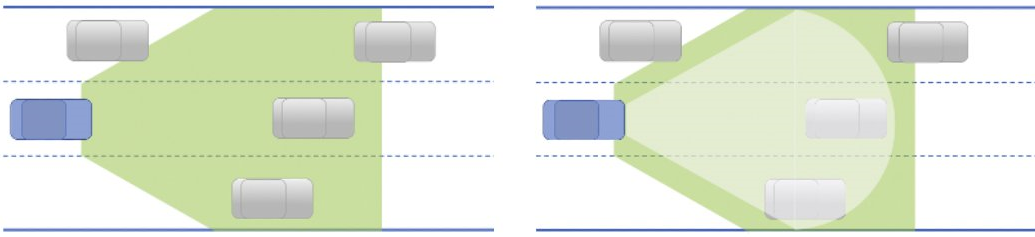
Typically, with the camera pointed straight forward, the capture area is the center lane and both adjacent lanes. The camera also has predefined pan detents every 22.5°. to capture left or right. In all but some specific cases described below, keep the camera facing straight forward for best ALPR results.
Performance
Temperature
The Fleet 3 camera will disable ALPR if the camera internal temperature exceeds 185 °F (85 °C). If starting a shift with a hot vehicle, running the air conditioner will help ALPR cool down to operating temperature in 10–15 minutes. The ALPR camera view will indicate ALPR OFF if the ALPR service is not available.
Capture rate and read accuracy
Capture rate is the percentage of plates read. Read accuracy is the percentage of reads that are accurate.
ALPR performance, much like driving visibility, is negatively affected by heavy precipitation or fog, especially when accumulated on the windshield. The camera must be able to see a plate clearly to read it. Generally, if you can't read the plate with your eyes, ALPR can't either.
An advantage of Axon ALPR over traditional systems is the benefit of the vehicle windshield wipers to clear precipitation from the camera’s view. Externally-mounted systems usually have no mechanism to clear the camera's view. While use of windshield wipers will mitigate the effects of precipitation, it will not completely eliminate it.
Windshield cleanliness and proper wiper maintenance/upkeep are also important factors in ensuring good ALPR performance; smudges or streaks due to worn wipers or dirty windshields will make plates appear blurry to the camera.
Fog will also degrade performance proportionally to its density.
Alert latency
ALPR will alert on a hotlist match within one second of the plate passing through the capture area.
Comparison to legacy ALPR systems
Legacy ALPR systems rely on camera technology that was initially developed for fixed ALPR applications. The typical ALPR camera focuses on one lane of travel, with a very narrow field of view and very specific focal length, yielding a capture area that is approximately 4x4x6 feet. Plates must pass through this small capture area to be read.
In fixed applications, this works quite well, but when mounted to a mobile application, the capture area is not static, so many plates simply do not pass through the read area and are never read. To counter this, these systems may employ multiple cameras.
Conversely, Axon Fleet 3 ALPR uses a wide 60° field of view covering three lanes out to 50 feet away. While a legacy ALPR system with two forward facing cameras has a detection area of approximately 192 cu. feet, Axon ALPR's detection area is nearly 90 times greater.


