Command Line Tutorial
Using XTMT from the Command line
By following these steps, you will upload files using XTMT using the Command line interface (CLI). Some users might find the .XTO file method simpler. The CLI option gives you the ability to use automation with XTMT, and can be used without creating an .XTO file for each operation.
Your agency might have required metadata which will be described below and will need to be applied to your implementation of XTMT operations. We recommend using a test agency, or if not available using a category for retention that will delete the test evidence.
Instructions for downloading and installing XTMT are found in XTMT Self-Service Migration Overview. For consistency with some samples we recommend putting the XDK file in the root drive. For example, c:\XDK\XDK-TestFiles and c:\XDK\XTMT_version
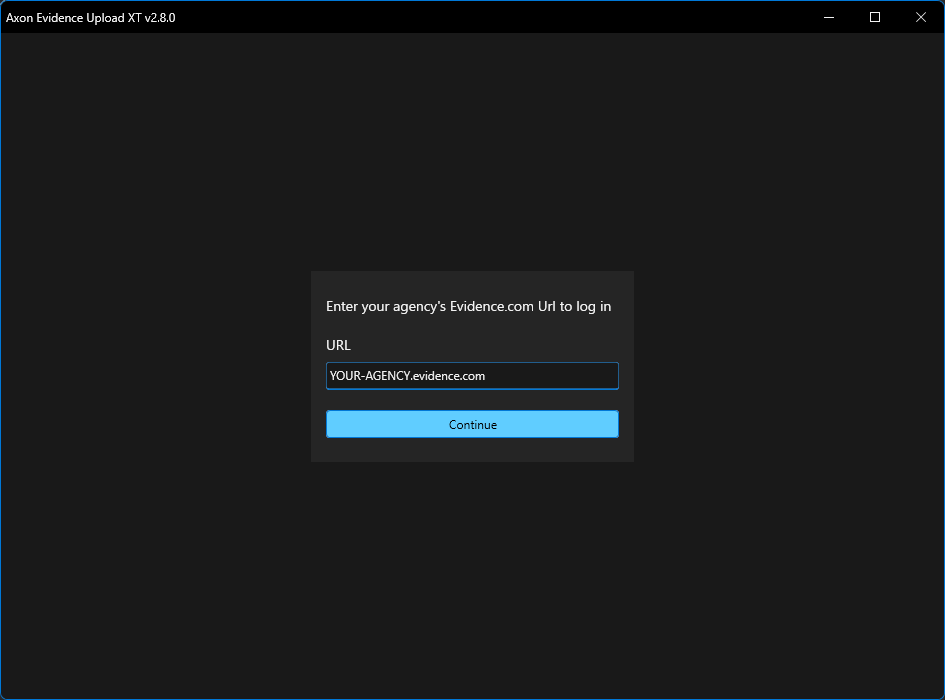
Sign into Upload XT
You need to sign in to the latest Axon Evidence Upload XT v2.x application to use XTMT. Sign in to Upload XT with either your existing Axon Evidence account or dedicated user account solely for uploads. You can only be signed in to Upload XT with a particular account on one device at a time. For your first upload testing, we recommend uploading to a test agency. Use non-evidentiary test files and a test operation name the first time.
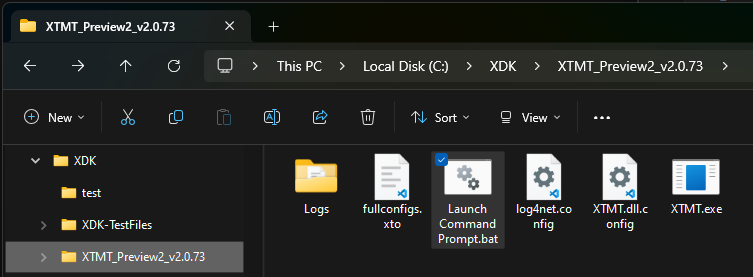
Launch XTMT from the Command Prompt
Open File Explorer and navigate to the latest XTMT release folder. Locate the “Launch Command Prompt.bat” file and double click it to launch a command prompt in the XTMT directory.
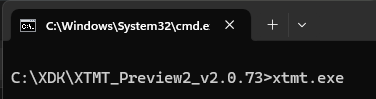
Execute XTMT.exe
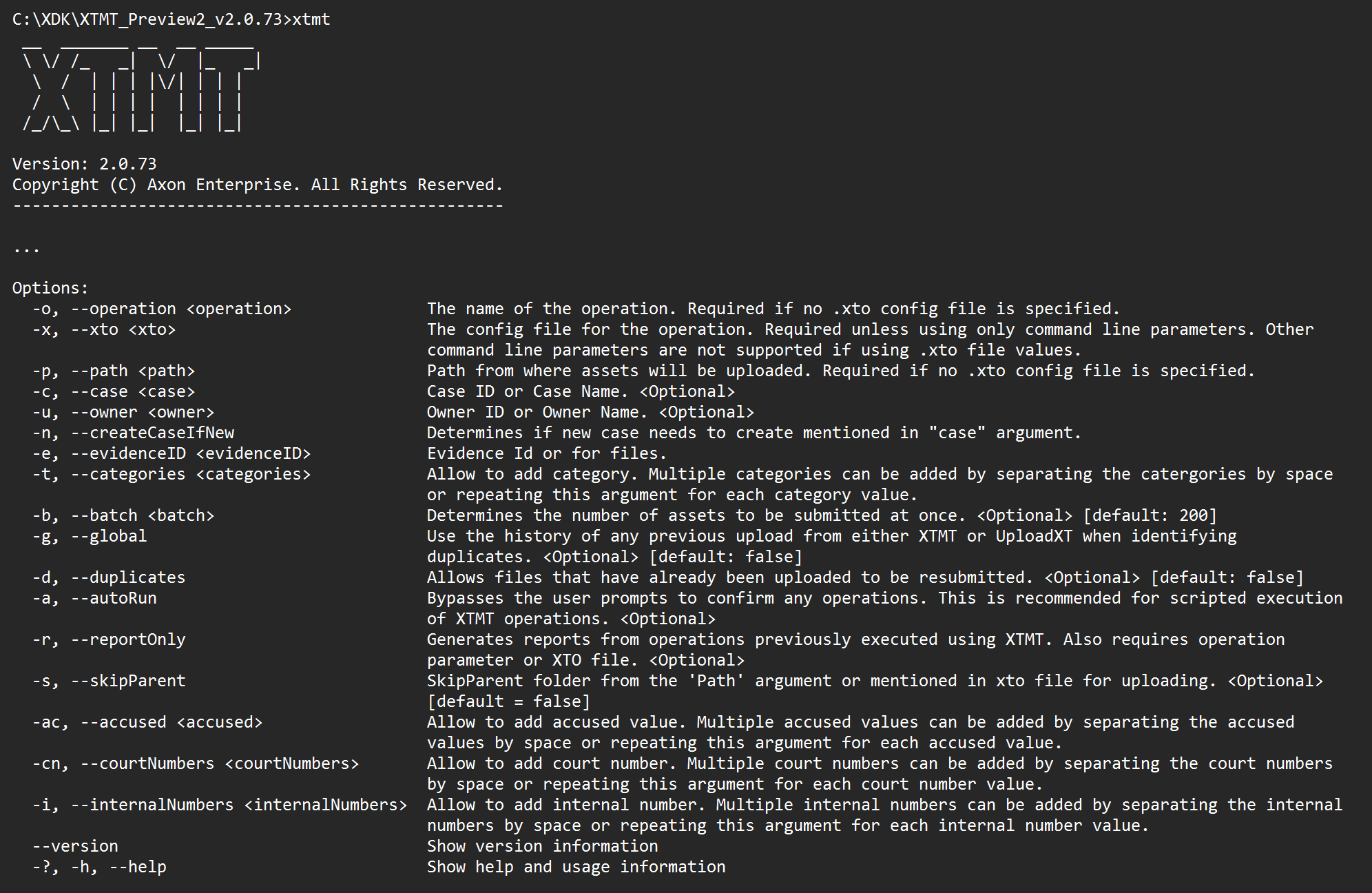
To see the tool output and options, type xtmt.exe at the command prompt and press Enter. This will not upload anything.
This will validate your authentication in Upload XT and display the latest information about usage, including the operation parameters that can be set in the command line.
Set the operation parameters
At the command line, enter the command xtmt.exe followed by --operation (or the abbreviation -o), the operation name inside quote marks, then the parameter --path (or the abbreviation -p) and the path name inside quote marks.
Example:
xtmt.exe -o "MyFirstXTO-CMD" -p "C:\XDK\XDK-TestFiles\HelloXTMT"Operation and Path are the minimum required parameters for the XTMT operation. Additional parameters can be added to the command, as described below.
Add metadata and parameters
You can also set the other operation parameters here by adding the commands after the Operation and Path.
For example, to set XTMT to check all files that have been uploaded on the device you're using for duplicates in the operation, but still allow duplicates to be uploaded:
xtmt -o "MySecondXTO-CMD" -p "C:\XDK\XDK-TestFiles\HelloXTMT" --global --duplicatesAdd metadata by entering the command followed by the metadata value in quote marks.
For example, to add an Evidence ID and set a category for the evidence:
xtmt -o "MySecondXTO-CMD" -p "C:\XDK\XDK-TestFiles\HelloXTMT" --global --duplicates --evidenceID "XTMT-testing" --categories "Pending Review"A list of all parameters and their required formatting is in XTMT Operation Parameters.
Categories
If you want to add multiple categories to the evidence, the Categories parameter must be formatted with each category value in quote marks and separated by a comma, like the following example:
--categories "Pending Review", "Closed"Case
You must add the evidence to a case if you want the folder structure maintained in Axon Evidence. Evidence not added to a case will be stored in Axon Evidence as individual, unorganized files.
If you want to add the evidence to a case, add --case (or the abbreviation -c) followed by the case name or ID in quote marks.
Continuing with the example above, it would look like:
xtmt -o "MySecondXTO-CMD" -p "C:\XDK\XDK-TestFiles\HelloXTMT" --global --duplicates --case "XTMT-test-case"If the case doesn't exist in Axon Evidence yet, you can create a case by adding --createCaseIfNew (or the abbreviation -n)
Continuing with our example:
xtmt -o "MySecondXTO-CMD" -p "C:\XDK\XDK-TestFiles\HelloXTMT" --global --duplicates --case "XTMT-test-case" --createCaseIfNewIf one case already exists with the given case name, the name will be reused. If multiple cases have the same name, use the case ID (GUID) instead.
Start the upload operation
When you have entered all the parameters you need for the operation, press Enter.
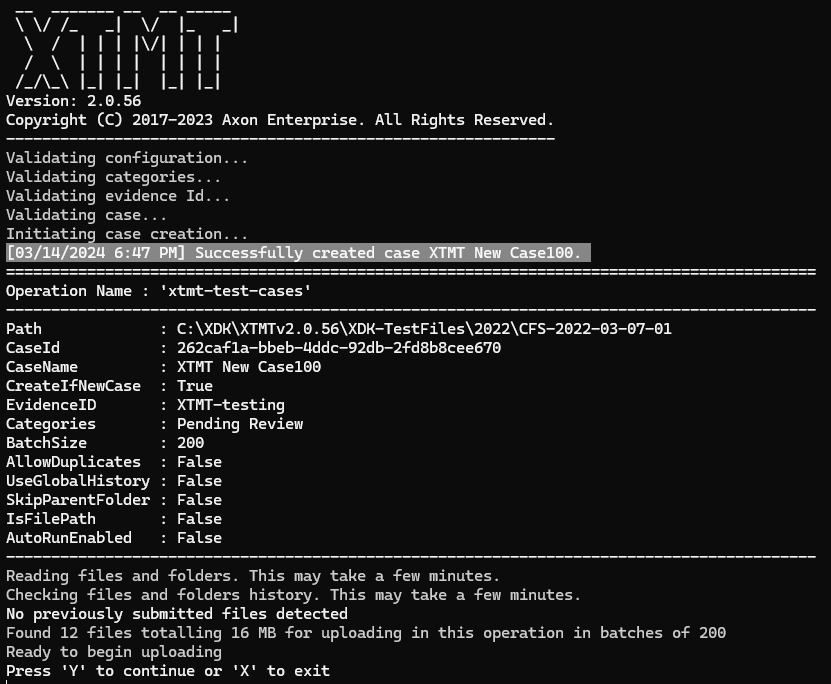
XTMT runs the operation and reports when the upload is complete:
Review in Axon Evidence
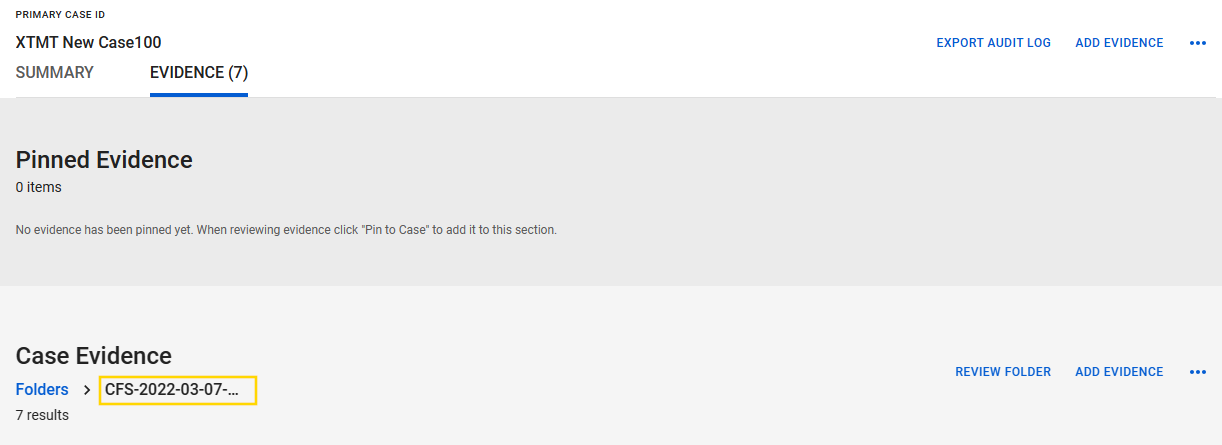
Sign in to Axon Evidence and search for the evidence to verify that files have been uploaded with the specified metadata. If you uploaded the files to a case, confirm the accuracy of the folder hierarchy as well.
Notice that in the following example, there is a folder created in the root of the case called "CFS-2022-03-07-01" which was the end of the Path value. To prevent this and only create folders for the children of the Path, include the parameter --skipParent (or the abbreviation -s).
Next steps
-
If you're ready to start using scripting to automate your XTMT operations, see XTMT Automation.


