NIBRS guidelines
To support NIBRS compliance, law enforcement organizations must follow specific requirements for offender reporting and property valuation. The guidance below consolidates FBI standards and Axon Records workflows for reporting offender data and property values.
Known and unknown offender reporting
The National Incident-Based Reporting System (NIBRS) lets law enforcement agencies report a separate set of offender data for each offender involved in an incident, whether or not an arrest has been made.
The term Known Offender does not imply the suspect’s identity is known; rather, the term indicates that some aspect of the suspect was identified, e.g., age, sex, race, or ethnicity. A Known Offender is different from an Unknown Offender, about whom no information is known.
Regardless of whether law enforcement reports specific offender data or declares that nothing is known about the Unknown Offender, at least one set of offender data must be connected to each offense in an incident report.
Reporting known offender(s)
When a user adds a Known Offender to an incident report and associates them with a NIBRS-reportable offense, they are required to complete additional fields, including age, sex, and race.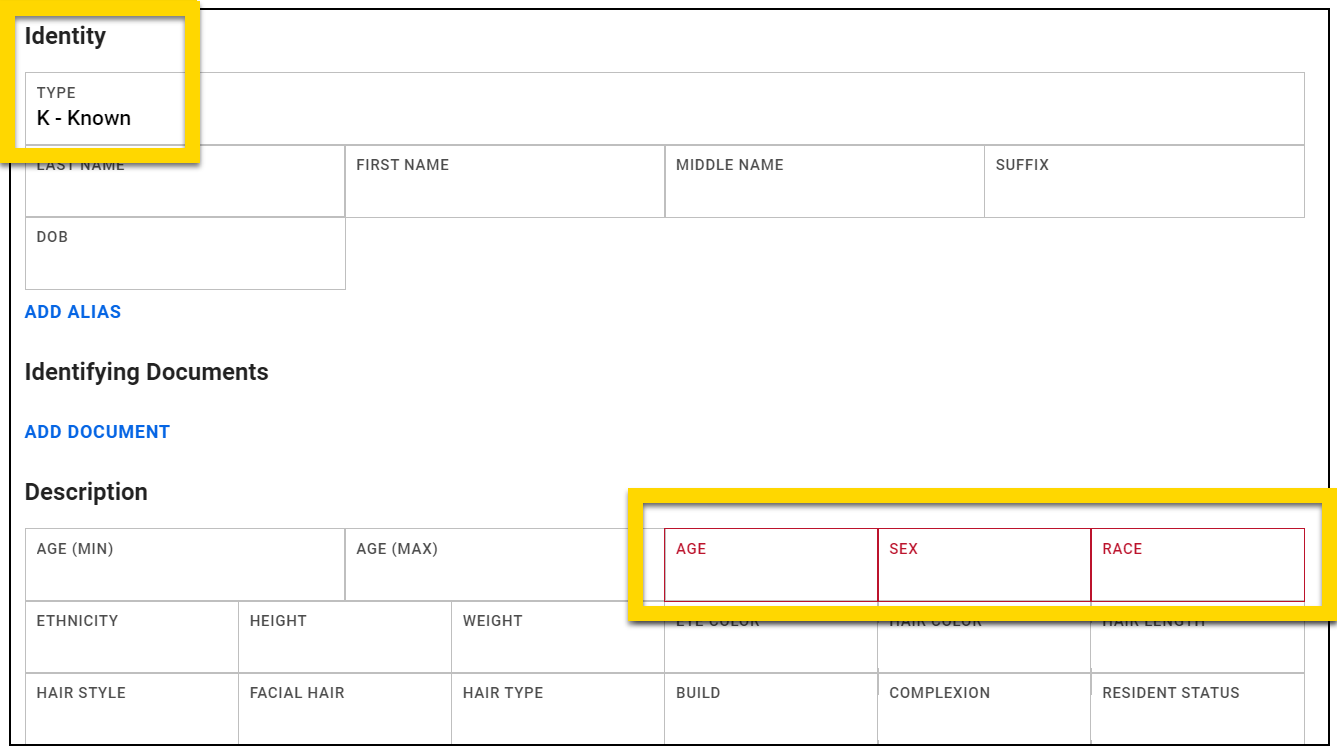
If an offender is unknown, but demographic information and/or the number of offenders are known, agencies should record these findings as Known Offenders.
In the 2021.1 version of the NIBRS User Manual, the FBI provides the following example:
A witness saw two offenders fleeing the scene of a Burglary, but because the burglars were wearing ski masks, the witness could not determine their age, sex, or race. The reporting agency should enter offender information for both offenders – Data Element 36 (Offender Sequence Number), that contain 01 and 02, and LEAs should report applicable data values in Data Elements 37 (Age of Offender), Data Element 38 (Sex of Offender), and Data Element 39 (Race of Offender) for each offender.
Axon Records captures the offender sequence numbers behind-the-scenes, making the appropriate associations on the submission file. The remaining data elements outlined in the example must be entered into the report or validation errors will occur.
Reporting unknown offender(s)
When nothing is known about the offender, agencies should select Unknown from the Identity > Type drop-down menu. This removes the rule validation on required data elements triggered for Known Offenders (i.e., age, sex, and race) and allows agencies to report the Unknown Offender.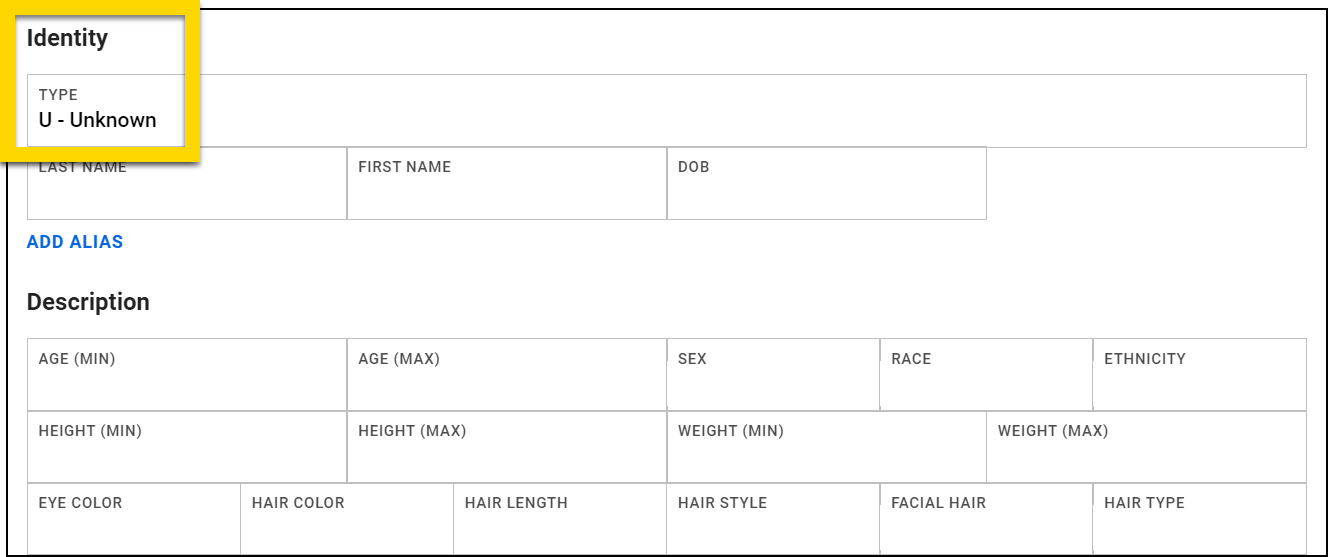
In the 2021.1 Version of the NIBRS Manual, the FBI provides the following example:
An LEA investigated an incident involving a corpse with five bullet holes who was found in an abandoned warehouse. There were no witnesses to the crime or suspects. Data Element 36 (Offender Sequence Number) should contain 00 = Unknown Offender.
Axon Records captures the Unknown Offender sequence number behind-the-scenes, and no additional information must be added to the report.
Update an incident
Once an investigation reveals additional information about an Unknown Offender, such as the identity, number of offenders, or demographics, organizations should create a supplement for the incident, update the person type from Unknown to Known, and update all required fields.
See Create supplement for more information.
Guidelines for NIBRS property valuations
The FBI UCR Program1 suggests the following guidelines for valuating property involved in a criminal incident:
- Round values to the nearest whole dollar.
- Use the fair market value for articles subject to depreciation because of wear and tear, age, or other factors causing the value to decrease with use.
- Use the victim’s valuation (in most instances) of items such as jewelry, watches, and other similar goods that decrease in value slightly or not at all with use or age.
- Use replacement cost or actual cash cost to victim for new or almost new clothes, auto accessories, bicycles, etc.
- Use the current market price at the time of the theft, seizure, etc. for negotiable instruments such as bonds payable to the bearer, etc.
- Score the theft of non-negotiable instruments such as traveler’s checks, personal checks, money orders, stocks, bonds, food stamps, etc., but do not record a value.
- Use the cost to the merchant (wholesale cost) of goods recovered, seized, stolen, etc., from retail establishments, warehouses, etc. In other words, use the dollar value representing the actual cash loss to the victim without any markup or profit added.
- When the victim obviously exaggerates the value of stolen/destroyed/damaged property for insurance or other purposes, law enforcement agencies should use common sense and good judgment to determine the value reported for the stolen items.
- Often the condition of the property is different at recovery than it was when stolen. law enforcement agencies should use the market value at the time of recovery even though it is less than the value reported at the time of the theft. If the value has increased by the time law enforcement recovers the property, the recovery value should not exceed its initial stolen value. Hair-splitting refinements are unnecessary.
Tip: Law enforcement organizations may use any type of resource to determine the value of property including the Internet, Craigslist, eBay, Kelley Blue Book, etc.
1 National Incident-Based Reporting System User Manual, v2021.1, page 109
Additional resources
For additional questions regarding NIBRS reporting, contact your State UCR program.


