Additional actions
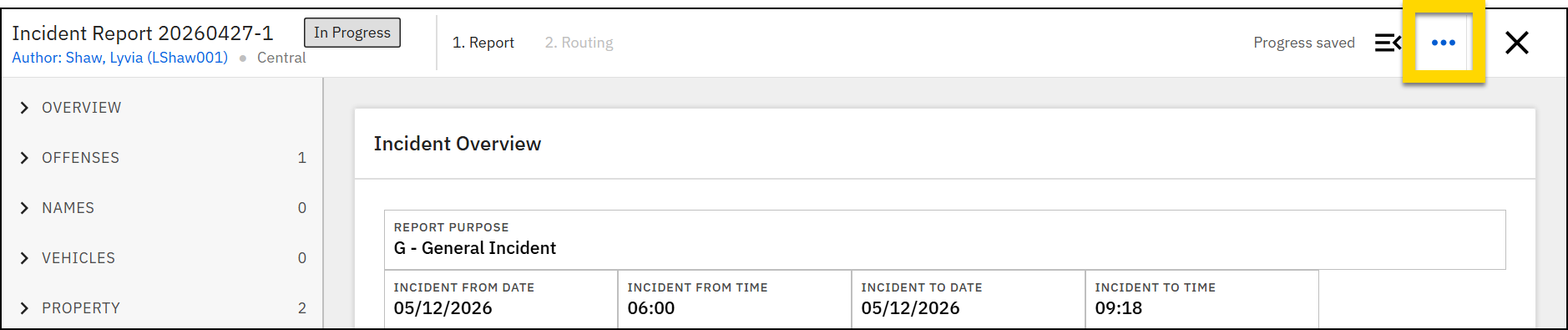
Once a report, incident, case, or investigation has been created, you can take various management actions from the More actions [...] menu in the top right corner of the report, including:
- Link related items
- View report history
- Copy information between reports
Print reports
Users with the appropriate privileges can print reports, incidents, events, and cases.
To print a single report:
- Open the report in Report Writer.
- In the top right corner of the report header, select More actions [ ... ] > Print report.
- Based on your organization's configuration, reports may have multiple print options, which each include different information from the report.
- Adjust the following settings. Note that some of these options may not appear for certain report types, and users must have certain privileges to adjust these settings.
- Print as a DOCX file: Select this checkbox to print the report as a DOCX file rather than a PDF. Contact your Axon representative for more information about this feature.
- Settings: Choose whether to include narrative images, restricted information, or the approval log in the printout.
- Header: Can be omitted, appear on all pages, or appear on just the first page.
- When you include a header in your printout, your organization's logo appears in the top right corner. This logo can be managed from your Organization Profile in the Axon Evidence Admin Console.
- Footer: Can be omitted, appear on all pages, and optionally include page numbers.
- Narratives: When the report contains multiple narratives, select which narrative is primary.
- A time stamp indicating when the narrative was first submitted for review will appear in the printed report. However, comments added during the review or routing process will not print.
- Provide Auditing details, which include recipient details and the purpose of the print.
- Select Next.
-
If you need to redact anything before printing, select Yes then Start redaction. If you are not redacting anything, select Print.
- See Redaction for more information.
- The file loads in a new browser tab where you can download and print it.
When you include a header in your printout, your agency's logo appears in the top right corner. This logo can be managed from your Agency Profile in the Axon Evidence Admin Console.
Print narratives from collaborative reports
Finalized reports
When a collaborative incident report is finalized, all the narratives can be printed, including the one you select as the primary narrative. The primary narrative will appear above all other reports when printed.
In-progress reports
If the report is still in progress and not finalized, you will only be able to print only your narrative when you print the report.
Other contributors' narratives
Your ability to print narratives contributed by others depends on your assigned privileges. If you need to print narratives from other contributors but are unsure about your privileges, contact your administrator for assistance.
Print incidents, cases, and investigations
To print an incident , case, or investigation follow these steps:
- Open the incident, case, or investigation profile.
- Open the More actions menu and select:
- Incidents and cases: Print incident
- Investigations: Print investigation
-
In the Documents section, indicate which content to include:
- For incidents, you can include:
- Full incident report: Includes the latest data and narratives from all supplements (including draft supplements).
- Incident reports: Indicate which reports to include. If you select the Full incident report option, all reports are included automatically.
- This option does not appear for investigations because investigations are not associated with an incident.
- File list: If selected, a list of all file names that have been added to the case are included in the printout.
- Evidence list: If selected, all property items associated with the incident that have a role of Evidence are included in the printout.
- Activity log: Includes all actions taken on the incident.
- In addition to the items listed above, for cases or investigations, you can include:
- Case or investigation summary
- Case or investigation documents
- Tasks
- Indicate if the printout should include a list of case tasks, or details for each task.
- Optionally include incomplete tasks.
- Set the order in which the tasks should be listed in the printout. Sort options include Task, Assignee, Status, Created at, Due date, and Completed at.
- For incidents, you can include:
- In the Settings section, optionally adjust the following items. Note that users must have certain privileges to adjust these settings.
- Change print format: This option only appears if the Full incident report option is selected in the Documents section.
- Select a print format option from the Incident report menu. The default format includes all report information. Other format options may not include all information and do not include some settings, a header, or a footer.
- Show table of contents: Includes a list of all sections in the printout with a header that gives basic details about the case.
- Show images in narratives: Includes images that have been inserted inline into the narratives.
- Show restricted information: If restrictions have been applied, this option includes restricted information that you have privileges to view. Optionally include this restricted information on a separate page.
- Show approval log: Details of the report approval process.
- Start each narrative on a new page: Inserts a page break at the start of each narrative.
- Change print format: This option only appears if the Full incident report option is selected in the Documents section.
- Adjust the Header and Footer:
- Header: Can be omitted, appear on all pages, or appear on just the first page.
- When you include a header in your printout, your organization's logo appears in the top right corner. This logo can be managed from your Organization Profile in the Axon Evidence Admin Console.
- Footer: Can be omitted, appear on all pages, and optionally include page numbers.
- Header: Can be omitted, appear on all pages, or appear on just the first page.
- Provide Auditing details, which include recipient details and the purpose of the print.
- Select Next.
- Use the Sort reports and documents by and the Order fields at the top to set the order in which items appear. Sort options include:
- Document type
- Name (if custom names have been created for any of the items)
- Date and time created
- Select Next.
- If you need to redact anything before printing, select Yes then Start redaction. If you are not redacting anything, select Print.
- See Redaction for more information.
- The file loads in a new browser tab where you can download and print it.
Link reports to an incident or event
To link a standalone (non-incident report) Axon Records report, like a Field Interview, to an incident or event (if your organization uses Axon Standards):
- Open the incident you want to link the report to and select More actions > Link other reports.
- This option does not appear on Axon Standards event profiles. Instead, link a report to the event by opening the report in Report Writer (explained below).
- Use the search box to search for the Report ID of the document you want to link.
- Select Link.
You can also perform this action while viewing the report:
- Open the report in Report Writer.
- In the top right corner of the report header, select More actions [...] > Manage related incidents.
- Search for the incident or event (if your organization uses Axon Standards).
- Select the incident or event you wish to link and press Enter on your keyboard to create the link.
- Linked incidents and events appear below the search bar.
- Select Save to finalize your changes.
Linked reports appear at the bottom of the incident profile in the Related documents section. Unlink a report by selecting More actions [...] > Unlink from incident.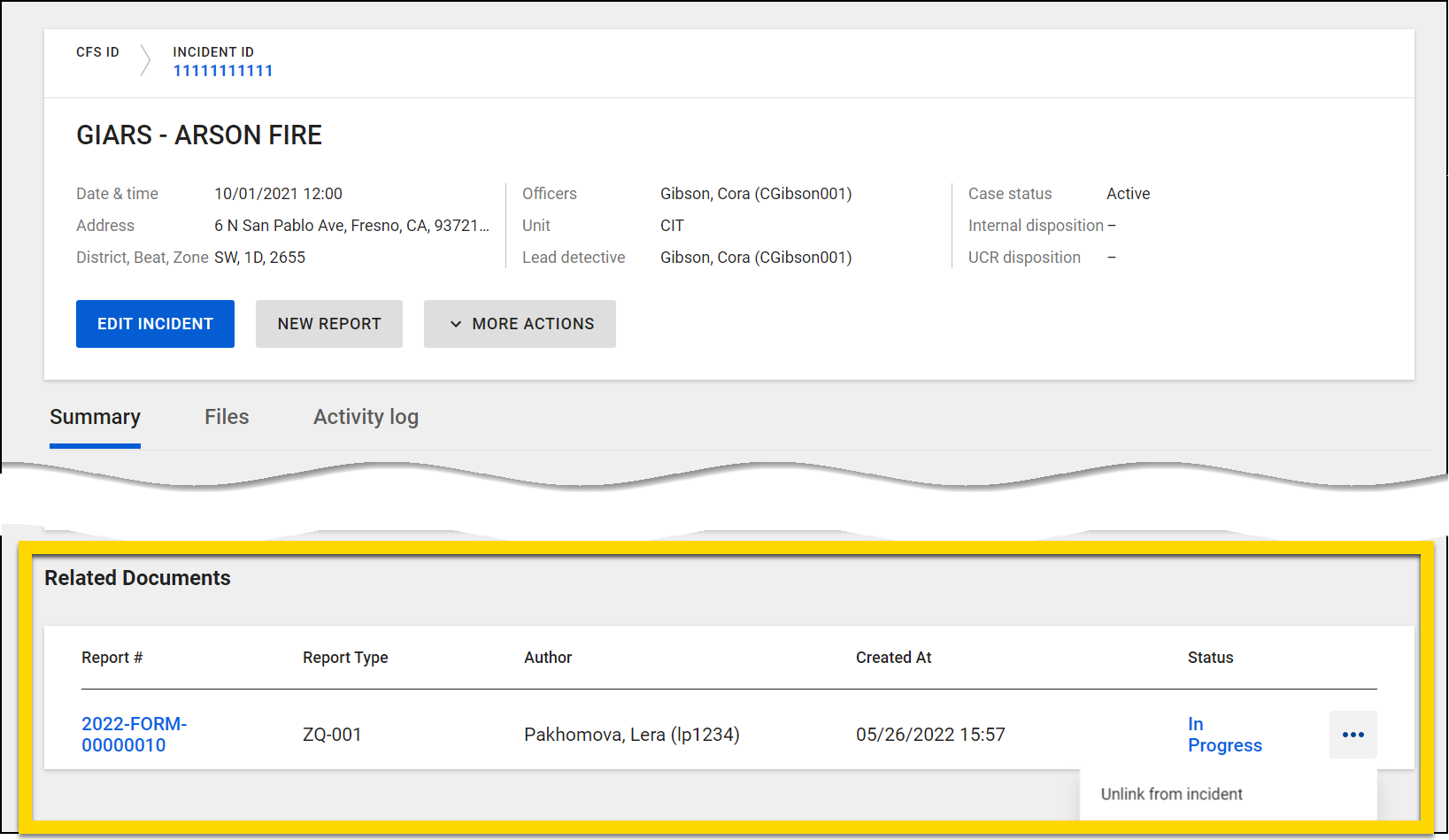
You can also remove a link by opening the report in Report Writer, selecting More actions [...] > Manage related incidents. Select Unlink > Save.
Link incidents and events
To link related incidents, or to link an incident to an event (if your organization uses both Axon Records and Axon Standards):
- Open an incident and select More actions > Link related incidents.
- If your organization uses both Axon Records and Axon Standards, this option appears as Link related incident reports and Standards events.
- Enter the Incident or Event ID you want to link to in the search box.
- Select the incident or event you wish to link and press Enter on your keyboard to create the link.
- Linked incidents and events appear below the search bar.
- Select Save to finalize your changes.
Related incidents and events appear at the top of the profile. Select the blue ID to open that profile in a new browser tab.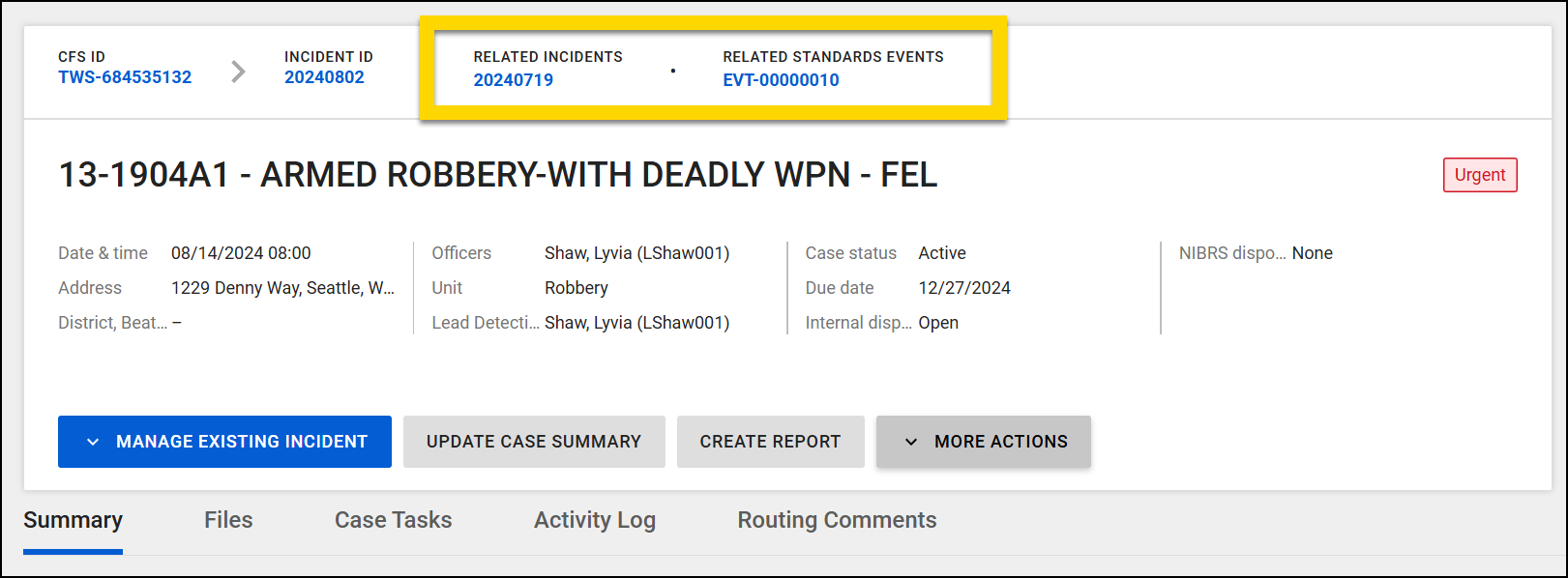
To remove links, select More actions > Link related incidents. Select Unlink to remove a link, then Save to finalize your changes.
View report history
To view a log of all actions taken on a report, select either the author name in the top left corner or More actions […] > View report history in the top right corner.
When viewing report history for incident reports, use the Sort by drop-down to change whether the audit log displays actions chronologically or broken out by contribution. Select Export CSV to export the report history to a CSV file, which includes each action and its timestamp.
Copy information to new reports
You can copy report information from an existing report into a new one. Information can be copied between different report types (e.g., from a Vehicle Pursuit report to a Vehicle Collision report).
This feature can only copy information from an existing report to a new report if the fields in both reports are named and configured the same way. For example, if the Location type field in the existing report is a dropdown field, the Location type field in the new report must also be a dropdown field (with the same name).
If your organization uses both Axon Records and Axon Standards, you can only copy information within the same database. For example, you can copy information from an Axon Standards reports to a new Axon Standards reports, but you cannot copy information from an Axon Standards report to an Axon Records report.
To copy information into a new report:
- Open the existing report.
- In the top right corner of the report header, select More actions [...] > Copy info to new report.
- Choose the type of report you want to create and how it should be linked to other reports and incidents:
- New incident report: Provide an Incident ID for the new incident report and choose whether or not the new incident should be linked to the existing incident.
- Narrative only: The new report will be linked to the existing incident.
- Standalone reports: You have several linking options when creating a new standalone report (i.e., a non-incident report):
- Link to the original incident: The new report displays in the Related documents section at the bottom of the incident profile.
- Add to the original incident: The new report displays in the Reports section on the incident profile.
- Do not link: The new report will not linked be to any incident.
- Select Preview info.
- Use the checkboxes to select which information will be copied into the new report.
- Some sections will be grayed-out and unselectable if a corresponding section does not appear in the new report (e.g., The existing report has a Vehicles section, but the new report you selected does not.).
- Select Create report.
- The new report opens in a new tab where you can review the copied information and complete all remaining fields.
Share reports
You can share a report by sending a message to specific people, Command Hierarchy groups, or teams. Reports created in Task inboxes can be shared, along with documents created in other modules (Case Management, Warrants, Permits, Bookings, etc.).
Share recipients receive an email as well as a notification in the Notification Center. See Notification Center for more information.
Users must have the Share report privilege before they can share reports. There are separate Share report privilege for Axon Records and Axon Standards, which give administrators granular control over which reports can be shared.
You can share a report at any time from within Report Writer or when submitting it for review or finalization.
To share a report from within Report Writer:
- Open the report in Report Writer.
- Select More actions [...] > Share report.
- In the Recipients field, select one or more individual users, Teams, or Command Hierarchy groups.
- You can combine multiple recipient types in the same share.
- Optionally, enter a message. This message is included in the notification the recipient receives.
- If you are sharing an incident report, the following metadata is included in the share email (if these fields are configured in your organization's incident reports):
- Incident occurrence date and time
- Offense
- Location
- District, Beat, and Zone
- This metadata is only included in the notification text for incident reports. It is not included for any other type of report or document.
- Select Share.
To share a report while submitting it:
- Open the report in Report Writer.
- Select Submit.
- On the report's routing screen, in addition to selecting a routing destination, marking the report urgent, or adding a note, select the Share the report with others option.
- Enter recipients and an optional message, as described above.
- Select Submit. The report is submitted and shared at the same time.
The recipients receive an email as well as a notification in the Notification Center. See Notification Center for more information.
Sharing restricted reports
If you share a restricted report with a person who does not have the necessary privileges to view reports where that restriction has been applied, they will not be able to open and view the report.
If you share a restricted incident report, you can optionally choose to include restricted metadata in the share email. If you share this restricted metadata with a user who does not have the appropriate restriction privileges, the metadata will still be included in the share email. However, when the user opens the report in Axon Records, they will not be able to view any information they do not have the necessary restriction privileges to view.
For more information about restrictions and restriction privileges, see:
Share history
To see if a report has been shared before:
- Open the report in Report Writer.
- Select More actions [...] > Share report.
- Switch to the View share history tab.
A table lists each share, including the following information:
- Shared by
- Shared at (date and time)
- Recipients (the total number of users, groups or teams)
Select Details to view full information about the share, including which recipients received the share and the message that was included.


